Founded: Opened October 2, 1895. Incorporated May 20, 1896
Location: 6 W. 20th St. (1896-?); 2000 N. Charles St. (by 1901), Baltimore, MD
Additional Information
- Dates: 1896
Notes: This hospital if supported by voluntary contributions, and the philanthropic are earnestly requested to become annual subscribers. Poor children of Baltimore and its immediate vicinity are received without any charge whatever, if their parents are unable to pay. Whenever a case is able to pay something, no matter how little, it is expected to do so to help maintain the hospital.
Source: Hospital for the Relief of Crippled and Deformed Children of Baltimore City, The First Annual Report of the Hospital for the Relief of Crippled and Deformed Children of Baltimore City Philadelphia: Avil Printing Company
- Dates: 1896
Notes: The Hospital for the Relief of Crippled and Deformed Children was opened on October 2, 1895, as a new and much needed charity in Baltimore.
It is required, because most of our hospitals do not care to take in the diseases (especially tuberculosis) which lead to deformity, as they run such a chronic course and cannot as a rule be operated on and discharged cured.
Our general hospital beds are taxed to their utmost with applicants suffering with acute diseases and these must needs be considered first.
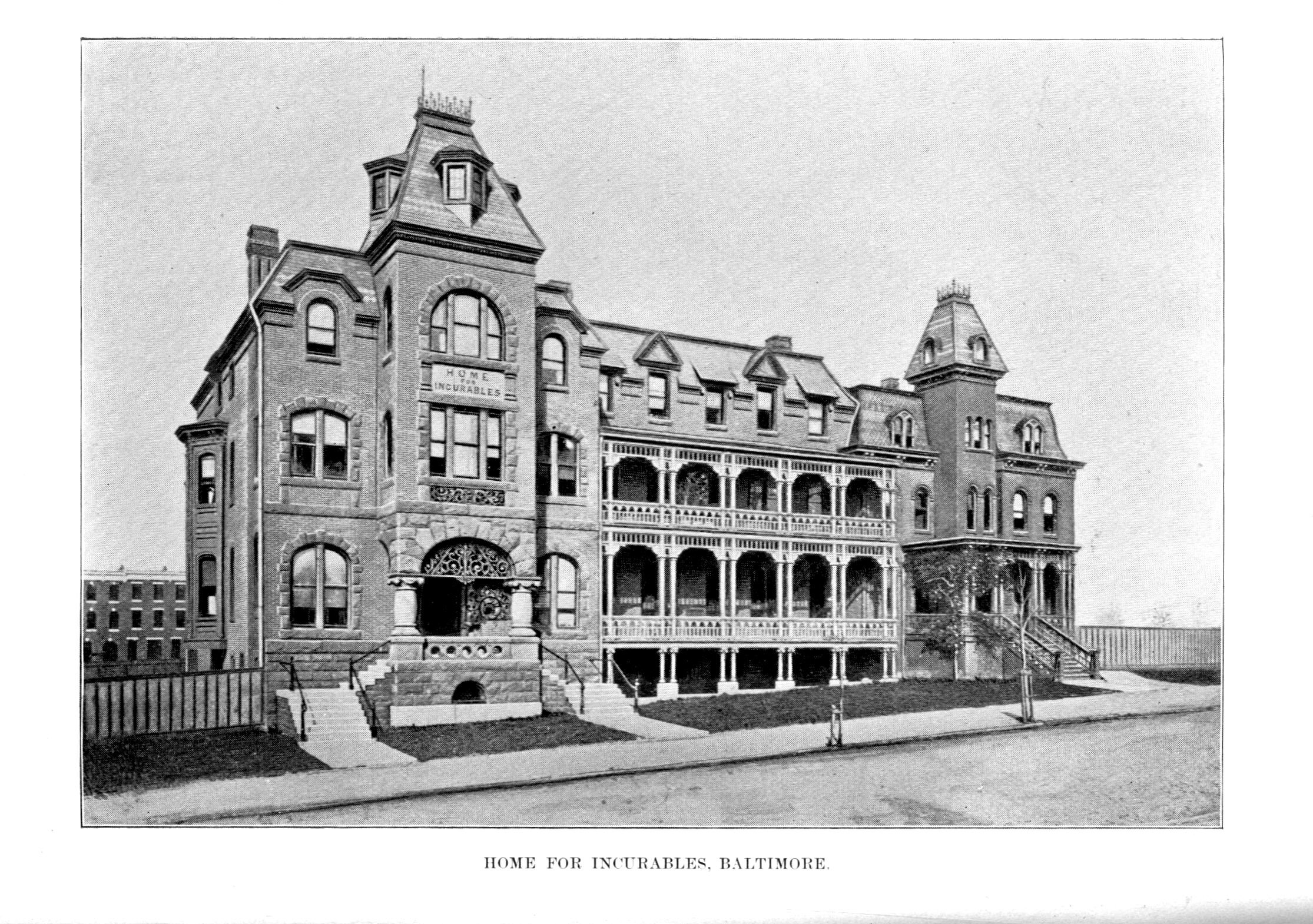
So this charity was inaugurated to help those cases which would otherwise go untreated and bear through life the stigma “Cripple” to find an asylum in the “Home for Incurables” or the Almshouse. This is the only specially equipped Hospital for treating deformity south of Philadelphia.
Many a crippled child if treated early enough, with continuous scientific treatment, the best nursing, food and clothing will be so thoroughly benefited that perfect recovery will be insured, if the parents or guardians will co-operate in the after treatment.
At present we can give but twelve of the little patients bed treatment at a time. We can take only white children into the hospital, because the number of beds is limited, but adults and colored children as well as convalescent white children may receive treatment in the Dispensary daily, except Sunday.
Source: Hospital for the Relief of Crippled and Deformed Children of Baltimore City, The First Annual Report of the Hospital for the Relief of Crippled and Deformed Children of Baltimore City Philadelphia: Avil Printing Company
- Dates: 1896
Notes: The Trustees of the Hospital for the Relief of Crippled and Deformed Children of Baltimore in presenting this first annual report, beg to announce that they have just purchased the house and lot at the northwest corner of Charles and Twentieth street, with a frontage on Charles street of one hundred feet and propose to occupy it as soon as it is vacated by the present tenant, which will at an early day.
Source: Hospital for the Relief of Crippled and Deformed Children of Baltimore City, The First Annual Report of the Hospital for the Relief of Crippled and Deformed Children of Baltimore City Philadelphia: Avil Printing Company: 4
- Dates: 1896
Notes: The one case of scarlet fever was the only infectious disease we had in the year and made most apparent our need of an isolation ward.
Source: Hospital for the Relief of Crippled and Deformed Children of Baltimore City, The First Annual Report of the Hospital for the Relief of Crippled and Deformed Children of Baltimore City Philadelphia: Avil Printing Company: 16
- Dates: 1896
Notes: Our wards are overcrowded, and on several occasions we have been compelled to decline to admit little sufferers to the beds for lack of room and establish a waiting list, when time meant so much, as to the ultimate cure, to some of the cases then in acute stage.
Source: Hospital for the Relief of Crippled and Deformed Children of Baltimore City, The First Annual Report of the Hospital for the Relief of Crippled and Deformed Children of Baltimore City Philadelphia: Avil Printing Company: 16
- Dates: 1896
Notes: A room for the assistant nurses is a most urgent need, for the one they now occupy is only six by ten feet, one sleeping in it by night and the other by day, a most unhealthy arrangement, especially for those whose vital powers are taxed to such an extent, and I trust some provision will shortly be made for them.
Source: Hospital for the Relief of Crippled and Deformed Children of Baltimore City, The First Annual Report of the Hospital for the Relief of Crippled and Deformed Children of Baltimore City Philadelphia: Avil Printing Company: 16
- Dates: 1896
Notes: We have extremely cramped quarters for store room for provisions, supplies, braces, etc., and also for necessary laboratory work.
Source: Hospital for the Relief of Crippled and Deformed Children of Baltimore City, The First Annual Report of the Hospital for the Relief of Crippled and Deformed Children of Baltimore City Philadelphia: Avil Printing Company: 16
- Dates: 1896
Notes: There is no play-room for the convalescent children, and their noise in playing in the wards, where often there is an ill child, or one that has just been operated on, is a menace to the success of our work.
Source: Hospital for the Relief of Crippled and Deformed Children of Baltimore City, The First Annual Report of the Hospital for the Relief of Crippled and Deformed Children of Baltimore City Philadelphia: Avil Printing Company: 16
- Dates: 1901
Notes: (Opened 1895; incor. 1896, 200 north Charles St., C.&P. telephone, Madison 459. Dispensary and training school for nurses attached. Object. — For the relief and care of crippled children, both white and colored, of the State of Maryland. Adults may receive dispensary treatment. Children from other States can not be received as free patients. A moderate charge for dressings, surgical operations, and treatment is made to those able and willing to pay. There are 40 free beds. Supported by general subscriptions, proceeds from entertainments, state appropriation (1901) $3,000, and by payments made by Supervisors of City Charities by whom the hospital is at present used for a limited number of city patients. Application for last class should be made to the office of the Supervisors of City Charities. Management. — By board of 9 trustees. Treated in 1900 in the dispensary, 1746; free cases in the wards, 209. General visitors welcome Sundays 12.30 to 1 p.m., Mondays and Saturdays 3 to 5 p.m. Visiting days for parents, Wednesdays and Sundays 3 to 5 p.m.
Source: Charity Organization Society, Directory of the Charitable and Beneficent Organizations of Baltimore together with Legal Suggestions, Etc. Baltimore: : 47
- Dates: 1901
Notes: 2000 N. Charles St. Convalescent white and colored children treated in the dispensary Tuesdays and Thursdays 10 a.m. to 12 m. (1900) 1746 free cases treated in the dispensary.
Source: Charity Organization Society, Directory of the Charitable and Beneficent Organizations of Baltimore together with Legal Suggestions, Etc. Baltimore: 41
- Dates: 1948
Notes: See: “Patience is Key to Polio Island Aiding Children” Evening Sun Jan. 15, 1948
- Dates: 1948
Notes: See also: “Kernan Hospital Reviews Service During 55 Years” Evening Sun Apr. 21, 1948
- Dates: 1978
Notes: See also: “Board make-up threatens Kernan charity ties” Sun Feb. 9, 1978
Bibliography
- Baltimore. Hospital for the Relief of Crippled and Deformed Children, Prospectus of the Hospital for the Relief of Crippled and Deformed Children: 6 West Twentieth Street, Baltimore, Md.: opened October 2d, 1895 Balitmore: , 1896?

 Medicine in Maryland, 1752-1920