Montevue Asylum

Founded: Established 1870
Location: Frederick, MD

Images
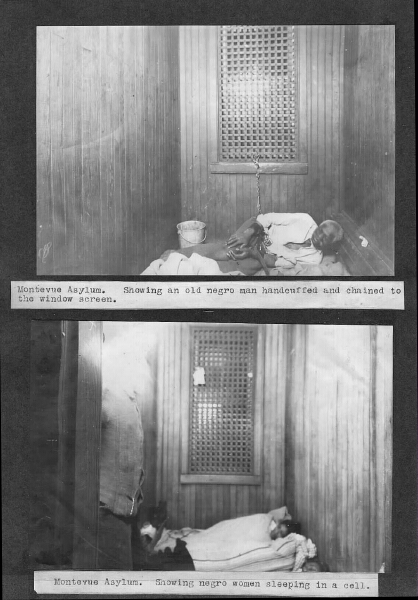
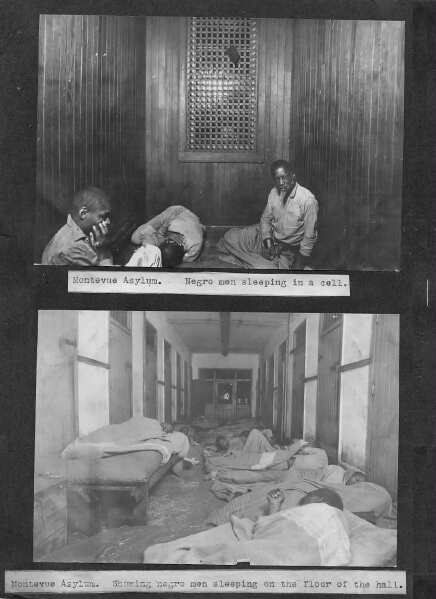
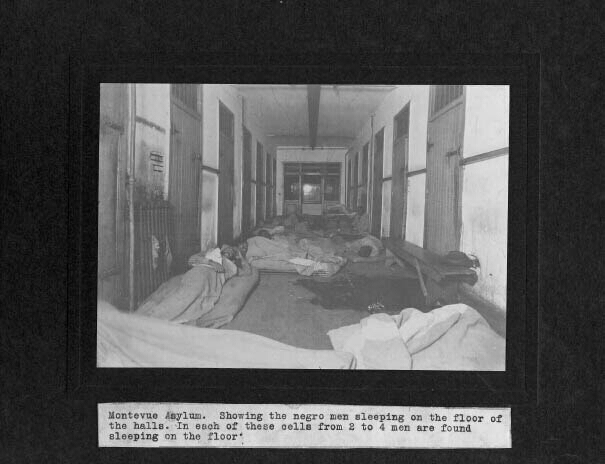
Montevue Asylum, View of cells, African American wards. 23rd Annual Report of the Maryland Lunacy Commission. Maryland State Archives

Montevue Asylum, View of cells, African American wards. 23rd Annual Report of the Maryland Lunacy Commission. Maryland State Archives

Montevue Asylum, African American male ward views. 23rd Annual Report of the Maryland Lunacy Commission. Maryland State Archives

Montevue Asylum, African American male ward views. 23rd Annual Report of the Maryland Lunacy Commission. Maryland State Archives

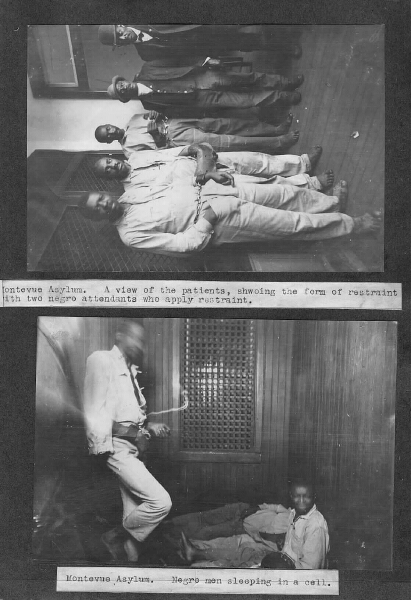
Montevue Asylum, African American males in restraint devices. 23rd Annual Report of the Maryland Lunacy Commission. Maryland State Archives

Montevue Asylum, African American males in restraint devices. 23rd Annual Report of the Maryland Lunacy Commission. Maryland State Archives

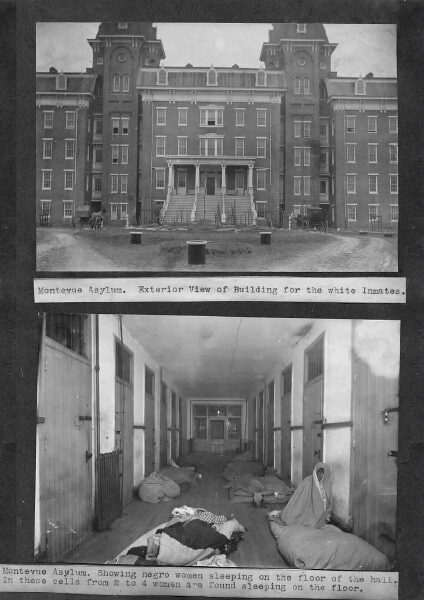
Montevue Asylum: white building; African American female ward. 23rd Annual Report of the Maryland Lunacy Commission. Maryland State Archives

Montevue Asylum: white building; African American female ward. 23rd Annual Report of the Maryland Lunacy Commission. Maryland State Archives

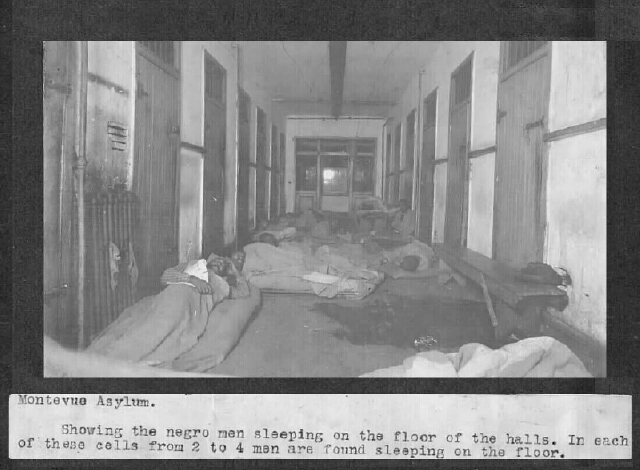
Montevue Asylum, African American male ward. 23rd Annual Report of the Maryland Lunacy Commission. Maryland State Archives

Montevue Asylum, African American male ward. 23rd Annual Report of the Maryland Lunacy Commission. Maryland State Archives

Montevuew Asylum. 23rd Annual Report of the Maryland Lunacy Commission. Maryland State Archives


Montevuew Asylum. 23rd Annual Report of the Maryland Lunacy Commission. Maryland State Archives

Montevue Asylum, Frederick County. 23rd Annual Report of the Maryland Lunacy Commission. Maryland State Archives

Montevue Asylum, Frederick County. 23rd Annual Report of the Maryland Lunacy Commission. Maryland State Archives

House of Refuge

Founded: 1812 as House of Industry; name changed 1831
Location: Frederick Road, Baltimore, MD

Images

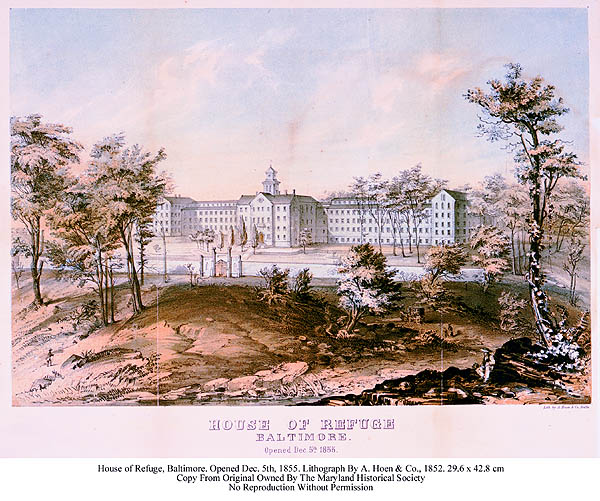
House of Refuge, Baltimore. Opened December 5th 1855. Lithography by A. Hoen & Co. From First Annual Report of the Managers of the House of Refuge, frontis. Maryland Historical Society

House of Refuge, Baltimore. Opened December 5th 1855. Lithography by A. Hoen & Co. From First Annual Report of the Managers of the House of Refuge, frontis. Maryland Historical Society

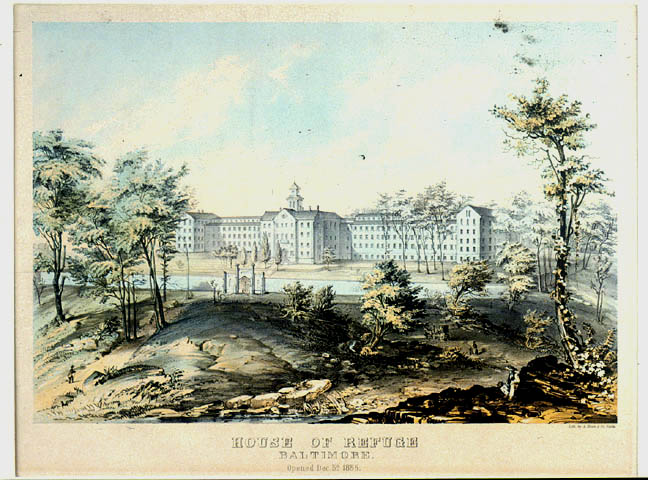
House of Refuge, Baltimore, Opened December 5, 1855. Artist: Unknown Other Contributor: A. Hoen & Co. Pict 16.15 x 11.11 1933 Notes : Lithograph by Hoen, 1855. This building, a home for unruly boys, stood on the hill west of Gwynns Falls near Frederick Avenue. At the laying of the cornerstone, October 27, 1851, Chief Justice Taney and Governor Lowe of Maryland were speakers. George W. Brown, afterward Mayor, was president of the board. Cator Collection, Print 120. Enoch Pratt Free Library

House of Refuge, Baltimore, Opened December 5, 1855.
Artist: Unknown
Other Contributor: A. Hoen & Co.
Pict 16.15 x 11.11
1933 Notes : Lithograph by Hoen, 1855.
This building, a home for unruly boys, stood on the hill west of Gwynns Falls near Frederick Avenue. At the laying of the cornerstone, October 27, 1851, Chief Justice Taney and Governor Lowe of Maryland were speakers. George W. Brown, afterward Mayor, was president of the board. Cator Collection, Print 120. Enoch Pratt Free Library

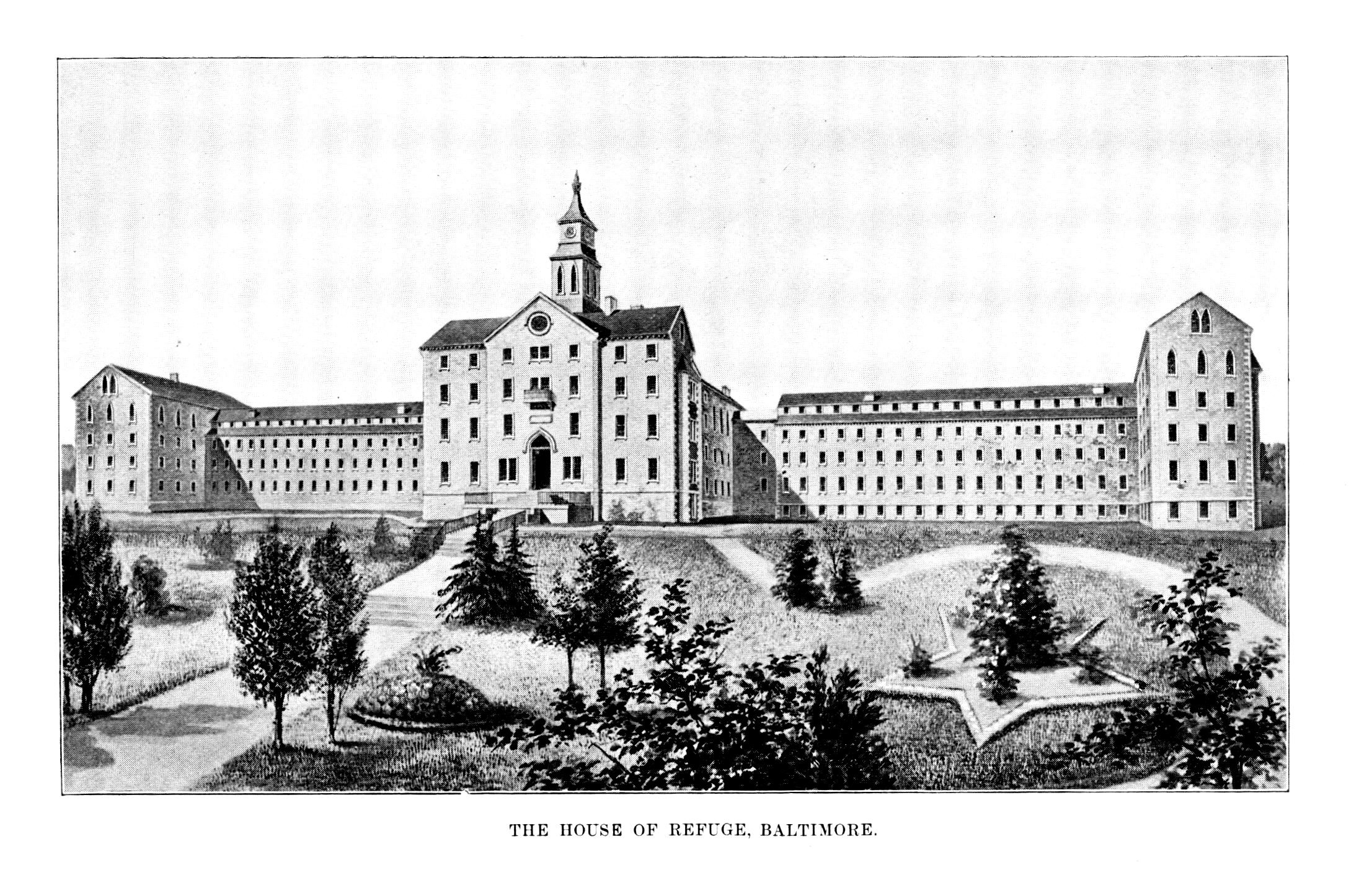
House of Refuge. Message of Frank Brown, Governor of Maryland, to the General Assembly at its Regular Session, January, 1894 (Baltimore: Wm. J.C. Dullany Company, 1894). Maryland State Archives

House of Refuge. Message of Frank Brown, Governor of Maryland, to the General Assembly at its Regular Session, January, 1894 (Baltimore: Wm. J.C. Dullany Company, 1894). Maryland State Archives

Additional Information

  • Dates: 1812/02/14
    Notes: House of Industry (later, 1831, House of Refuge) organized by Drs. Edward Johnson, James McHenry, George Roberts, James H. McCullough and others (February 14).
    Source: Cordell, Eugene Fauntleroy, Medical Annals of Maryland 1799-1899 Baltimore: The Medical and Chirurgical Faculty for the State of Maryland: 679
  • Dates: 1894
    Notes: HOUSE OF REFUGE, situated on the Frederick Road, in the western suburbs of Baltimore city, was chartered in 1831, and embraces a lot of fifty-five acres. The large buildings were erected at a cost of $260,000, which amount was contributed by the State of Maryland, the city of Baltimore and by private contributors. It is a reformatory institution where incorrigible boys are committed at the request of their parents. Others are committed for misdemeanors and sundry offenses. The institution provides for a plain, practical English education, and has workshops for mechanical training in the practical branches of industry, many of the boys being engaged in printing, some as wood-workers, and others in the metal-working department. The need of an institution of this character is generally recognized by the citizens of the State. The State of Maryland appropriates the sum of $15,000 annually towards its support. This is followed by an appropriation from the city of Baltimore of about the same amount.
    Source: Message of Frank Brown, Governor of Maryland, to the General Assembly at its Regular Session, January, 1894 Baltimore: Wm. J.C. Dullany Company: 70


Hospital Saturday and Sunday Association of Baltimore

Founded: 1882
Location: Baltimore, MD

Additional Information

  • Dates: 1901
    Notes: (1882), Secretary, Dr. E.F. Cordell, 1526 John St. Object.– To support free beds in the hospitals of Baltimore; by drawing out gifts for hospital work, especially by collections at appointed times, in churches and public places, to be given under the management. (To institutions designated by the donors, if desired.) Management.– Some 150 members, with executive and distributing committees. Churches and synagogues have contributed. The collections, Hospital Saturday and Sunday, November 24-25, 1900, were $905.81.
    Source: Charity Organization Society, Directory of the Charitable and Beneficent Organizations of Baltimore together with Legal Suggestions, Etc. Baltimore: 59


Hospital of Woman’s Medical College of Baltimore

Founded: Established and incorporated 1882
Location: Corner McCulloh and Hoffman Streets, Baltimore, MD

Additional Information

  • Dates: 1894
    Notes: HOSPITAL OF THE WOMEN’S MEDICAL COLLEGE OF BALTIMORE, was incorporated in 1882, and is situated on the corner of McCullph and Hoffman streets, Baltimore. It has accomodations for twenty-five patients. The number treated since the establishment of the hospital is 934. The number of out-door patients is 23,238. The majority of the in-door patients are admitted owing to injuries and surgical diseases; railroad, machinery, and other accidents. The cost of the present building was $6,5000. The General Assembly of 1892 appropriated the sum of $1,500 annually, upon the condition that the said hospital should receive from each county in the State and from each legislative district in Baltimore City, one free patient at a time each year upon the certificate of the County Commissioners of each county, and the Board of Health of the city of Baltimore.
    Source: Message of Frank Brown, Governor of Maryland, to the General Assembly at its Regular Session, January, 1894 Baltimore: Wm. J.C. Dullany Company: 88
  • Dates: 1901
    Notes: Woman’s Medical College, Hospital of the, formerly the Good Samaritan Hospital (Estab. and incorp. 1882), corner McCulloh and Hoffman Sts. Office, 1030 McCulloh St. Telephone, C&P, Madison 121-m. A general hospital. No limitations upon admission, but a physician’s certificate is desirable. Application for admission should be made to the resident physician, or to Dr. Kintzing, 1818 north Charles St., chairman. There are 30 beds, some are free. Visitors are admitted Thursday and Sunday afternoons. State appropriation (1901), $1500, giving a free bed for each county of Maryland and for each legislative district of Baltimore.
    Source: Charity Organization Society, Directory of the Charitable and Beneficent Organizations of Baltimore together with Legal Suggestions, Etc. Baltimore: : 58