Post Hospital Fort McHenry (1814)

Location: Fort McHenry, Baltimore, MD

Images

Plan & Sections of Drill Ground at Fort McHenry, Md. Including ordnance, store-rooms, stables hospital grounds, hospital and graveyard. Record Group 77. National Archives

Plan & Sections of Drill Ground at Fort McHenry, Md. Including ordnance, store-rooms, stables hospital grounds, hospital and graveyard. Record Group 77. National Archives

Bibliography

  • Bradford, S. Sydney, “II. Fort McHenry: 1814” Maryland Historical Magazine (54): 188-209
  • Meyer, Sam, “Religion, Patriotism and Poetry in the Life of Francis Scott Key” Maryland Historical Magazine (84): 267-274
  • Sheads, Scott, “‘Yankee Doodle Played’: A Letter from Baltimore 1814” Maryland Historical Magazine (76): 380-382
  • Sheads, Scott, “Defending Baltimore in the War of 1812: Two Sidelights” Maryland Historical Magazine (81): 253-258
  • Walsh, Richard, “Fort McHenry: 1814” Maryland Historical Magazine (54): 59-60
  • Walsh, Richard, “III: The Star Fort: 1814” Maryland Historical Magazine (54): 296-309
  • Weeks, Barbara K., “‘This Present Time of Alarm’: Baltimore Prepares for Invasion” Maryland Historical Magazine (84): 259-266
 

Baltimore Special Dispensary

Founded: 1861
Location
: Baltimore, MD

Additional Information


Post Hospital Fort Marshall

Founded: 1862
Closed: June 13, 1866
Location: Eastern outskirts of the city near Canton in the neighborhood of Patterson Park, Baltimore, MD

Additional Information

  • Dates:
    Notes: Garrisoned by the 5th New York Heavy Artillery from May 1862 to April 23, 1864 and later by the 11th Indiana and the 1st U.S. Veterans Volunteers
    Source: Indexes to Field Records of Hospitals, 1821-1912. Maryland. National Archives, Washington, DC. RG94 E544


Baltimore Southern Dispensary

Founded: Incorporated 1870
Location: 106 West Hill Street, Baltimore, MD

Additional Information


Baltimore Second Dispensary

Location: Baltimore, MD

Bibliography

  • Baltimore, A series of letters and other documents relating to the late epidemic or yellow fever; comprising: the correspondence of the mayor of the city, the board of health, the executive of the State of Maryland, and the reports of the faculty of and District Medical Society of Baltimore. Also, essays of the physicians, in answer to the mayor’s circular requesting information for the use of the city council in relation to the causes which gave origin to this disease — To which is added, the late ordinance reorganizing the board of health, & c. &c. Published by the authority of the mayor with the consent of the authors for the benefit of the Second Baltimore Dispensary… Baltimore: William Warner, 1820


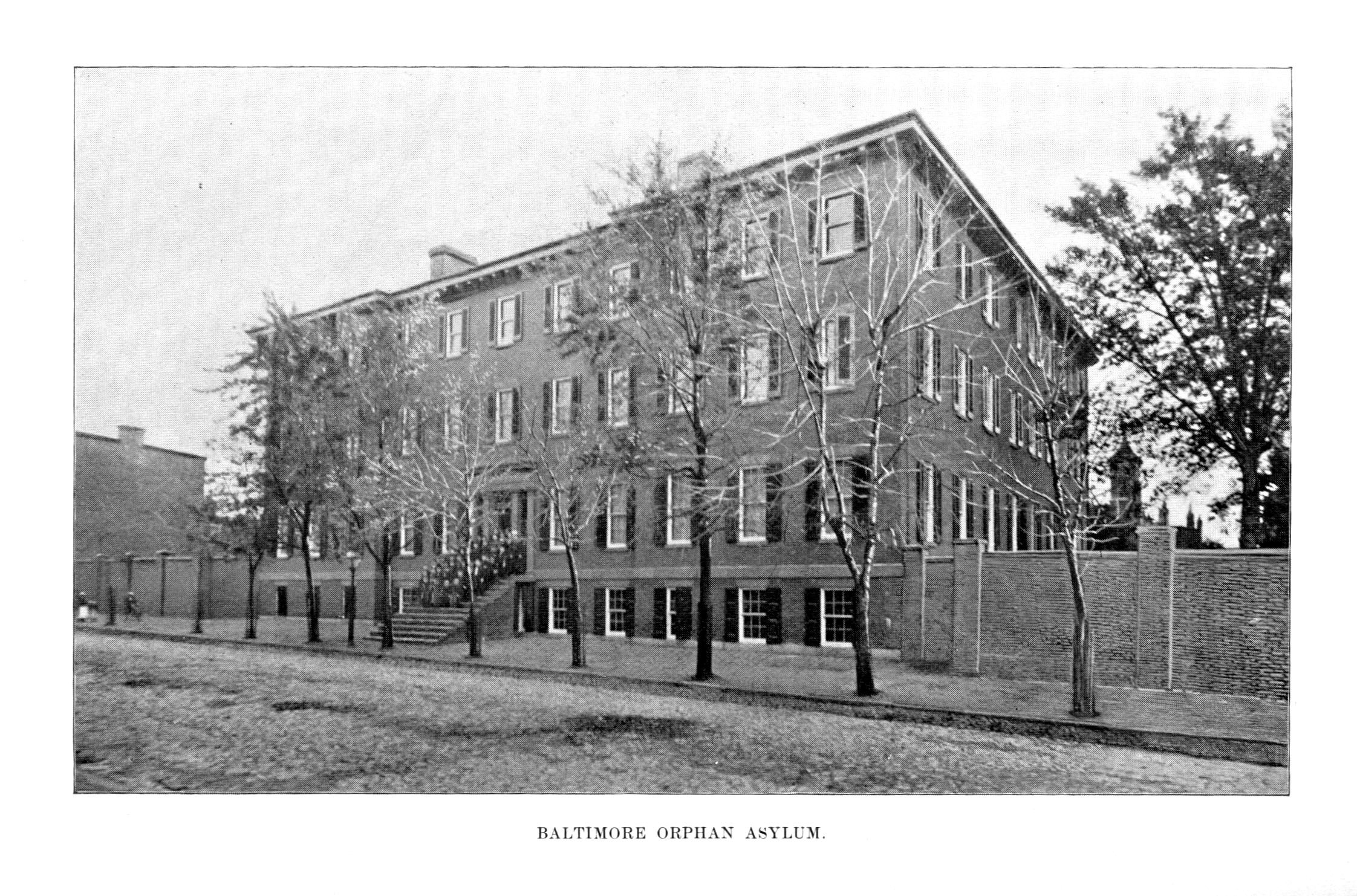
Baltimore Orphan Asylum

Founded: Founded 1778. Incorporated 1801.
Location: 215 N. Stricker Street (Stricker and Lexington Streets), Baltimore, MD

Images

Baltimore Orphan Asylum. Message of Frank Brown, Governor of Maryland, to the General Assembly at its Regular Session, January, 1894 (Baltimore: Wm. J.C. Dullany Company, 1894).. Maryland State Archives

Baltimore Orphan Asylum. Message of Frank Brown, Governor of Maryland, to the General Assembly at its Regular Session, January, 1894 (Baltimore: Wm. J.C. Dullany Company, 1894).. Maryland State Archives

Additional Information

  • Dates: 1894
    Notes: THE BALTIMORE ORPHAN ASYLUM is situated at Stricker and Lexington streets. The cost of the property as it now stands is $40,000. It was organized in 1778, and incorporated in 1801. The estimated number of inmates in this institution since its foundation is 2,000. The capacity of the institution is 175; the number of inmates at present, 110. This institution is claimed to be the oldest non-sectarian charitable institution in the United States. In view of the good work accomplished, the citizens of Maryland have just cause to be proud of it.
    The income of the asylum is derived principally from annual donations and from the interest on its invested funds, consisting of legacies which have been bequeathed to it from time to time.
    The total receipts during the last year were $7,363.97. The General Assembly of 1892, for the first time in seven years, appropriated the sum of $2,000 to assist in repairing and improving the buildings. The amount seems to have been economically expended, and the institution is in every way a credit to its efficient Board of Managers. The appropriation referred to being an assistance to a worthy charity was not misplaced.
    Source: Message of Frank Brown, Governor of Maryland, to the General Assembly at its Regular Session, January, 1894 Baltimore: Wm. J.C. Dullany Company: 94
  • Dates: 1920
    NotesAmounts appropriated for state-aided institutions, from the Maryland Manual, 1921-1922.