Robert Garrett Hospital Dispensary

Founded: 1889
Location: 27 N. Carey Street, Baltimore, MD

Additional Information

  • Dates: 1901
    Notes: (1888) 27 north Carey St. A part of the Robert Garrett Hospital for Children. hours, daily 12 m. to 1 p.m. Monday, Wednesday, and Friday is also open from 11 a.m. to 12 m. for the treatment of surgical diseases; Wednesday and Friday from 10 to 11 a.m. for the treatment of nervous affections. Dispensary open all the year in Baltimore, although Hospital moves to Mt. Airy for the summer. Both white and colored children under 13 years of age are treated in Dispensary. Intended only for those unable to pay a physician. Visits to Dispensary, 1900, 5692; prescriptions filled, 5390.Source: Charity Organization Society, Directory of the Charitable and Beneficent Organizations of Baltimore together with Legal Suggestions, Etc. Baltimore: : 42
 

Grace Church Dispensary

Founded: May 1885
Location: Caroline Street near Monument Street, Baltimore, MD

Additional Notes

  • Dates: 1901
    Notes: ROBERT GARRETT HOSPITAL FOR CHILDREN (1889), 27 north Carey St.; Maryland telephone, Courtland 1328. City buildings closed from June 1 to September 15 of each year, when Hospital occupies the Robert Garrett Sanitarium for Children, at Mt. Airy, Maryland. Dispensary attached to Hospital. A general hospital for white children of 12 years of age and under. Admission. — By application at the Dispensary, between 12 m. and 1 p.m. daily, except Sunday. Incurable or imbecile children cannot be received. Every child must be seen by one of the four physicians connected with the Hospital before being admitted. Satisfactory guarantees must be given that the child will be removed when the Hospital management desires. Intended only for those unable to pay a physician; no fees charged. There are 26 beds in the Hospital proper, and 7 in isolation ward for contagious diseases. Assistance is sometimes given to patients to aid in procuring necessary apparatus for hip joint or spinal diseases, etc. Between 250 and 300 children are treated in hospital wards each year. Supported by Mrs. Robert Garrett. Present hospital outgrowth of a private dispensary started on Caroline Street near Monument Street, May 1885. Then known as the Grace Church Dispensary, though maintained by Mrs. Garrett.
    Source: Charity Organization Society, Directory of the Charitable and Beneficent Organizations of Baltimore together with Legal Suggestions, Etc. Baltimore: : 47-48

German Aged Men & Women’s Home [Geman Aged People’s Home]

Location: Baltimore and Payson Streets, Baltimore, MD

Additional Information

  • Dates: 1894
    Notes: THE GERMAN AGED PEOPLE’S HOME, situated at the corner of Baltimore and Payson streets, Baltimore, cost $65,000. This institution, although organized by citizens of German birth, makes no discrimination in the admission of applicants as to nationality or creed. In the erection of the building the Board of Directors were largely assisted by the Ladies’ Aid Society, an auxiliary to the Board of Directors. Since the construction of the building there have been 131 beneficiaries. This institution is presided over by a careful Board of Managers, who are very active and energetic in their efforts to provide for the aged and infirm who have been so very fortunate as to find this comfortable home in their declining years. The annual expenses of this institution are $6,000, which amount is largely made up by contributors; the General Assembly of Maryland appropriating the sum of $1,500 per annum. The necessities for an institution of this character to provide for the aged men and women of our State are well recognized, and it would seem that the action of the General Assembly of 1892 in assisting this institution cannot be questioned.
    Source: Message of Frank Brown, Governor of Maryland, to the General Assembly at its Regular Session, January, 1894 Baltimore: Wm. J.C. Dullany Company: 85


General German Protestant Orphan Asylum

Founded: 1863
Location: Aisquith and Orleans Streets, Baltimore, MD

Images

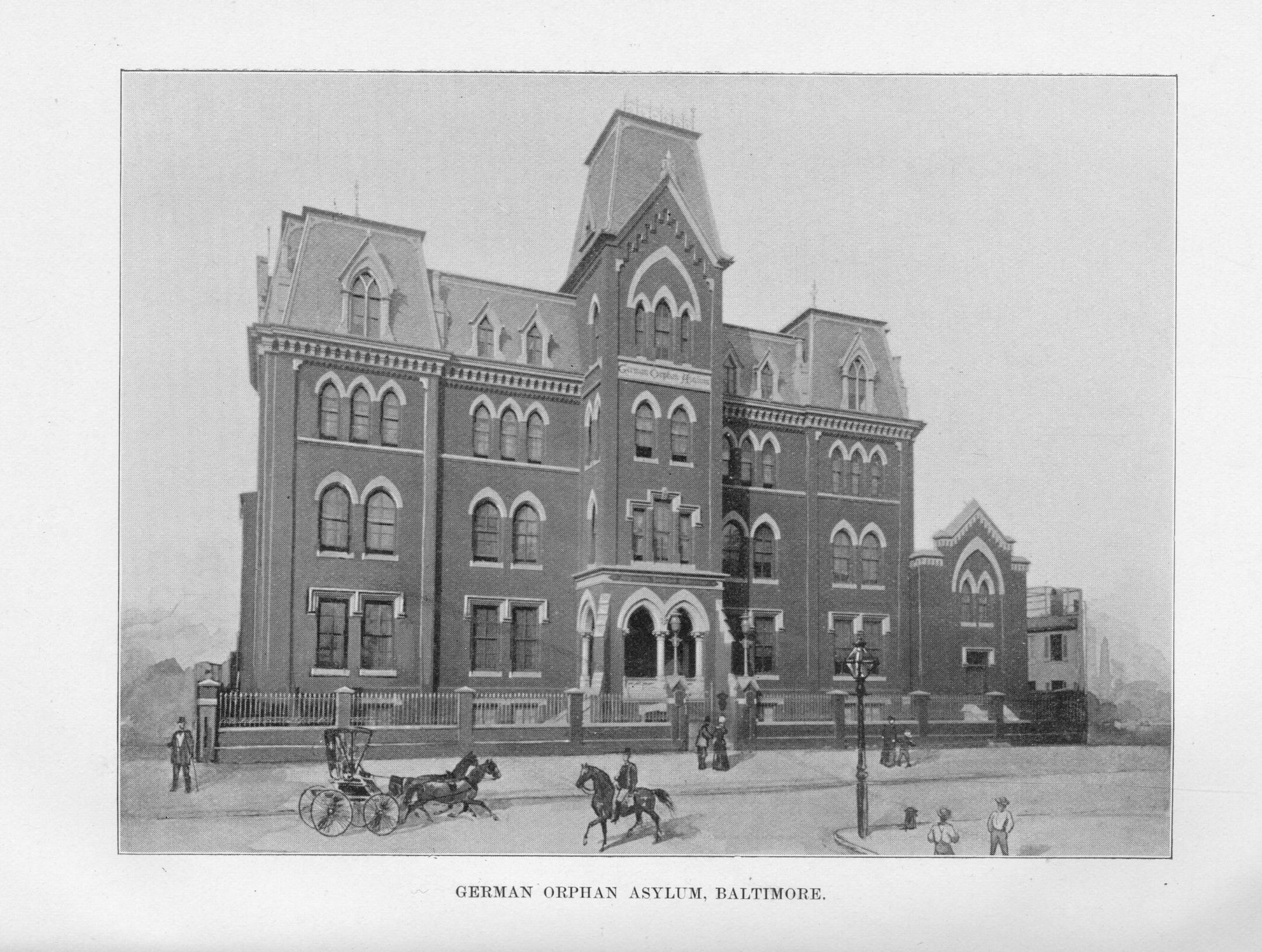
German Orphan Asylum, Baltimore. Message of Frank Brown, Governor of Maryland, to the General Assembly at its Regular Session, January, 1894 (Baltimore: Wm. J.C. Dullany Company, 1894). Maryland State Archives

German Orphan Asylum, Baltimore. Message of Frank Brown, Governor of Maryland, to the General Assembly at its Regular Session, January, 1894 (Baltimore: Wm. J.C. Dullany Company, 1894). Maryland State Archives

Additional Information

  • Dates: 1863
    Notes: German Protestant Orphan Asylum organized.
    Source: Quinan, John Russell, Medical Annals of Baltimore from 1608 to 1880, including Events, Men and Literature to which is added a Subject Index and Record of Public Services Baltimore: Press of Isaac Friedenwald: 42
  • Dates: 1894
    Notes: THE GENERAL GERMAN ORPHAN ASYLUM OF BALTIMORE CITY,situated on Aisquith street, near Orleans street, Baltimore, was organized in 1886, the cost of the property being about $85,000. Since the organization of this institution there have been 573 orphan children received, and there are at present 110 beneficiaries.

    The work of this institution has been honestly and faithfully performed, and many of the unfortunate have been provided with homes in families within the city and State. By the training in the asylum, and the general surveillance by the officers and managers of the institution, many have become industrious and worthy citizens. The State of Maryland, through the General Assembly of 1892, made an appropriation of $2,000 per annum, which seems to have been carefully and prudently expended under the efficient Board of Managers, and which appropriation was a contribution to a worthy charity.

    SourceMessage of Frank Brown, Governor of Maryland, to the General Assembly at its Regular Session, January, 1894 Baltimore: Wm. J.C. Dullany Company: 86


Female Orphan’s Asylum

Founded: by 1851. Incorporated Feb. 6, 1864
Location: St. Paul’s Church, Madison Avenue ext. (by 1851), Baltimore, MD

Additional Information

  • Dates: 1864
    Notes: Female Orphan Asylum endowned by Samuel Ready with 360,000; incorporated February 6.
    Source: Quinan, John Russell, Medical Annals of Baltimore from 1608 to 1880, including Events, Men and Literature to which is added a Subject Index and Record of Public Services Baltimore: Press of Isaac Friedenwald: 43
  • Dates: 1873
    Notes: Samuel Ready, a native of Baltimore County, but for many years a lumber-dealer in our City, left at his death $400,000, for the establishment of an Asylum for Female Orphans. Early in life his attention was attracted to those pitiful waifs who stray into lumber-years, and earn a precarious livelihood by the pickings and frequently, stealings they may gather thence.He was painfully aware of the manifold temptations to which they are exposed and the aim of his existence appears to have been, by rigid economy and close application to business, to set apart a sufficient sum to provide these little creatures with a shelter and home.
    Source: Howard, George, The Monumental City, its Past History and Present Resources Baltimore: J.D. Ehlers & Co: 51