U. S. General Hospital West’s Buildings

Founded: September 19, 1862
Closed: June 1, 1865. Patients transferred to Jarvis General Hospital
Location: Concord Street near Union Dock, Baltimore, MD

Additional Information

  • Dates: 1862-1865
    Notes: Hospital records available at the National Archives, Washington, DC. See RG94 Entry 553 for listing of available hospital registers.
  • Dates: 1863-1864
    Notes: Confederate prisoner hospital July 1863 to February 1864
    Source: Indexes to Field Records of Hospitals, 1821-1912. Maryland. National Archives, Washington, DC. RG94 E544
  • Dates:
    Notes: WEST’S BUILDINGS, BALTIMORE, MD., consisted of a block of six warehouses each having three stories and an attic. The brick walls had no interior finish, but as they were thirty-four inches thick moisture was seldom observed to penetrate them. These houses were each 24 feet wide, but their depth varied from 107 to 124 feet. The ceilings were too low for the area of the rooms, being 11 feet high on the first floor, 9 feet 6 inches on the second and 9 feet and 2 inches on the third floor. The first floor was unsuitable for ward use, — it was flagged, and deficient in light and ventilation; it contained the offices, kitchens, bakery, dining-room, laundry, store-rooms, guard’s quarters and a few small rooms for employees.

    The twelve rooms on the second and third stories were used as wards. Their dimensions corresponded with those of the several buildings; they contained from 32 to 39 beds each, giving a hospital capacity of 400 beds with 800 cubic feet of air per bed. The wards of each floor communicated freely with each other by doorways in the party walls. The four exterior wards, two on each floor, had good light and ventilation by 10 windows each, 4 along the length of each ward and 3 at each end; but the eight interior wards on each story, were lighted and ventilated only by the end windows. The wards were reached by interior stairways having no direct communication with the external air. To improve the ventilation wooden shafts were extended from the ceilings of the various wards to the ridge of the roof, but no current was established through them, as they were too narrow and turned twice almost at right angles in their course. The wards were unequally heated by coal-stoves. There were four bath-rooms and water closets, two on each floor, or one to every three wards, but as each closet contained only one seat a majority of the patients had to make use of the sinks in the yard. The water-closets were fitted with urinals, but as these were untrapped they emitted an ammoniacal vapor. The attics were used as store- and knapsack-rooms and as quarters for nurses. The officer of the day had a room on the flagged first floor, but no other officer had quarters in the building.

    Source: Medical and Surgical History of the Civil War, Vol. VI [Formerly entitled The Medical and Surgical History of the War of the Rebellion (1861-1865)] Wilmington: Broadfoot Publishing Co.: 901
 

St. Agnes Sanitarium

Founded: 1863
Location
: Lanvale St. (1863-1875); Wilkens Ave. (1875-), Baltimore, MD

Additional Information


U. S. General Hospital Patterson Park

Founded: April 19, 1862
Closed:  June 15, 1865. Patients transferred to Hicks General Hospital
Location: Barracks in the Patterson Park, eastern suburbs of the city at head of E Baltimore Street and near Fort Marshall, Baltimore, MD

Additional Information

  • Dates: 1863-1964
    Notes: Served as a general hospital April 18, 1862 to March 14, 1863; convalescent hospital March 15, 1863-April 1864; and general hospital May 1864 to its closure.
    Source: Indexes to Field Records of Hospitals, 1821-1912. Maryland. National Archives, Washington, DC. RG94 E544

Bibliography

  • Luckey, John, The Flag of truce Baltimore: Printed by James Young …, 1862

Maryland General Hospital

Founded: 1886
Location: Linden Ave. and Madison Street, Baltimore, MD

Additional Information

  • Dates: 1901
    Notes: The following hospitals have ambulances for the conveyance of sick persons to the hospital named in the title:The City Hospital, Calvert and Saratoga Sts.
    Johns Hopkins Hospital, Broadway and McElderry St.
    The Maryland General Hospital, Linden Ave. and Madison St.
    The Maryland University Hospital, Greene and Lombard Sts.
    St. Joseph’s Hospital, Caroline and Hoffman Sts.
    The Health Department, City Hall Annex, has a ambulance to convey cases of contagious disease to the Quarantine Hospital.
    The Supervisors of City Charities have contracted with the following hospitals for the conveyance of city patients: Maryland General, Maryland University, City Hospital, St. Joseph’s, and Homeopathic.
    United States Marine Hospital Service has an ambulance which conveys sick sailors to the hospital.
    Source: Charity Organization Society, Directory of the Charitable and Beneficent Organizations of Baltimore together with Legal Suggestions, Etc. Baltimore: : 46
  • Dates: 1908-1911
    Notes: Baptisms from Maryland General Hospital, 1908-1911 can be found on microfilm at the Maryland State Archives, Annapolis in:
    SPECIAL COLLECTIONS (Co-Cathedral – Minor Basilica of the Assumption of the Blessed Virgin Mary) Baptisms 1958-1976, pp. 82-330; Maryland General Hospital 1908-1911; General Index; Marriages 1783-1861, pp. 1-407. MdHR M 1517.
  • Dates: 1920
    NotesAmounts appropriated for state-aided institutions, from the Maryland Manual, 1921-1922.
  • Dates: 1928
    Notes: One of the oldes and most important of Baltimore’s medical institutions is the Maryland General Hospital, at Linden avenue and Madison street, incorporated in 1882.The hospital has its start on West Baltimore street in a building previously occupied by an orphan asylum, but within a few years the present site of the main building was acquired and a new home constructed.After a long affiliation with the Baltimore Medical College the Maryland General came under the management of the Methodist Church in 1911, its board of directors representing the Methodist Episcopal, the Southern Methodist and Methodist Protestant Churches — the first project to be undertaken by the three branches of the denomination.

    Later the buildings of the Baltimore Medical College, at Linden and Monument street, and the Baltimore Dental College, on North Howard, were added to the hospital’s equipment. In 1923 a new nurses’ home was built, at a cost of $160,000, and other improvements and additions brought the capacity of the hospital up to 230 patients.

    See: “Baltimore in Pictures” News (Baltimore) Jan. 17, 1928

  • Dates: 1963
    Notes: Images of the original Maryland General Hospital. See: Sun Jun. 7, 1963

Bibliography

  • What we give we have : Maryland General Hospital, Linden Avenue & Madison Street, Baltimore, Maryland. Baltimore: The Hospital, 1946
  • Doerfler-Evans, R., “An historical overview of Maryland General Hospital.” Maryland Medical Journal (44 (4)): 275-8

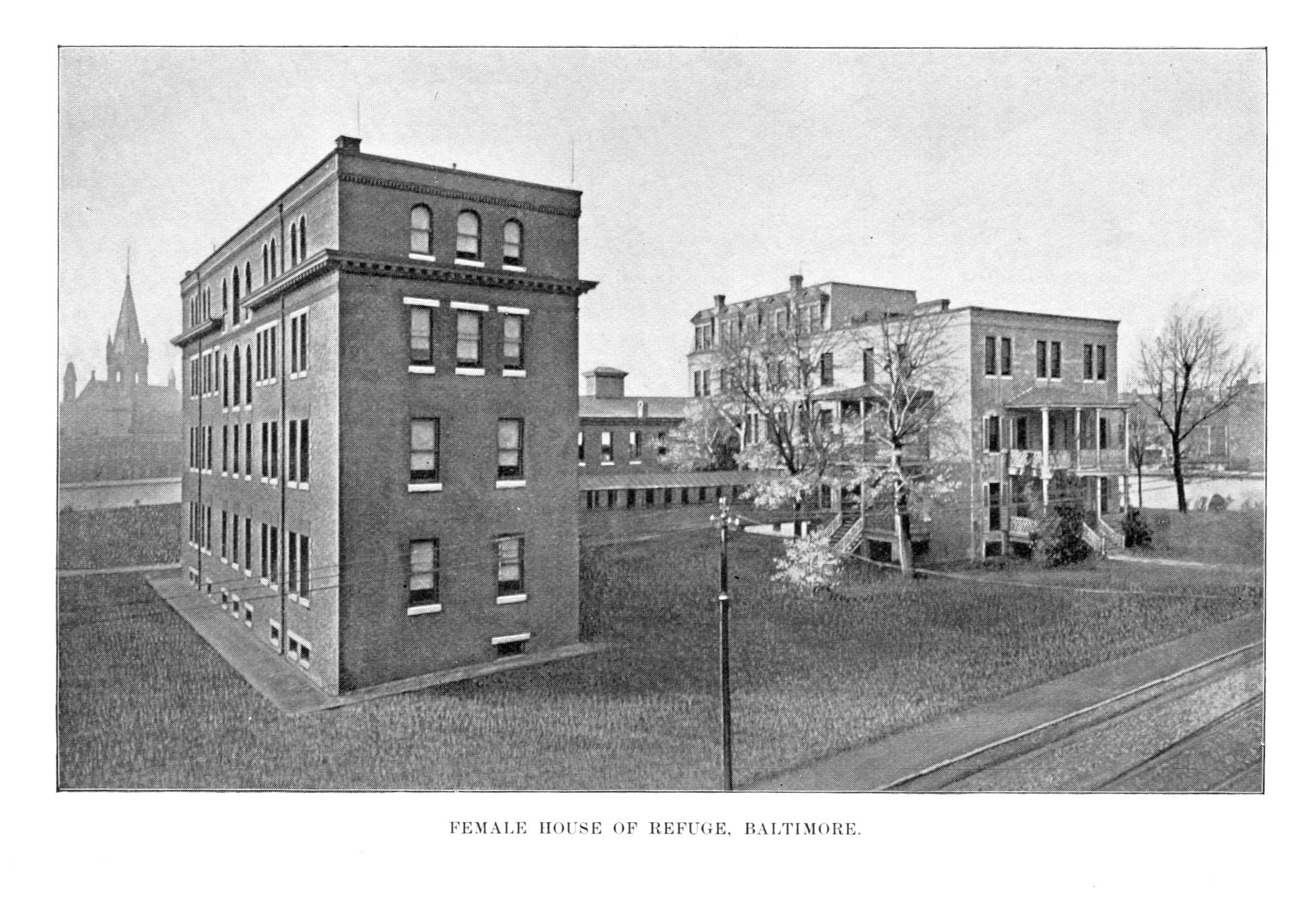
Female House of Refuge

Founded: Incorporated 1866
Location
: Baker and Carey Streets, Baltimore, MD

Images

Female House of Refuge, Baltimore. Message of Frank Brown, Governor of Maryland, to the General Assembly at its Regular Session, January, 1894 (Baltimore: Wm. J.C. Dullany Company, 1894). Maryland State Archives

Female House of Refuge, Baltimore. Message of Frank Brown, Governor of Maryland, to the General Assembly at its Regular Session, January, 1894 (Baltimore: Wm. J.C. Dullany Company, 1894). Maryland State Archives

Interior, Female House of Refuge. Message of Frank Brown, Governor of Maryland, to the General Assembly at its Regular Session, January, 1894 (Baltimore: Wm. J.C. Dullany Company, 1894). Maryland State Archives

Interior, Female House of Refuge. Message of Frank Brown, Governor of Maryland, to the General Assembly at its Regular Session, January, 1894 (Baltimore: Wm. J.C. Dullany Company, 1894). Maryland State Archives

Additional Information

  • Dates: 1894
    Notes: THE FEMALE HOUSE OF REFUGE, was incorporated in 1866. It is a reformatory institution for young girls, situated at the corner of Baker and Carey streets, Baltimore. It cost about $60,000, of which amount the State gave $10,000, and the remainder was made up from private contributions from benevolent citizens of the city of Baltimore. They have had in their charge since the erection of the building 583 girls, who are taught the ordinary English branches, housework, sewing, moral and religious training, and a system of work has been adopted by which the girls are trained in woman’s industries, and they receive a large percentage of their earnings from the sales of the work, which amount is deposited in Savings Banks to their credit. They are regularly graded according to merit, and whenever deemed prudent are placed in good homes, or returned to their relatives. Some, of course, return to their former evil lives, but a large proportion are permanently reformed. The present building will accommodate something over one hundred, giving each one a separate sleeping apartment. The average number of inmates is about seventy. This institution is assisted annually by the State of Maryland, and by the city of Baltimore. The State appropriation in 1892 was $5,000 per annum.
    Source: Message of Frank Brown, Governor of Maryland, to the General Assembly at its Regular Session, January, 1894 Baltimore: Wm. J.C. Dullany Company: 89


U. S. General Hospital Adams House

Founded: September 13, 1861
Closed: May 1862. Patients transferred to McKim’s Mansion
Location: Adams House Hotel, southwest corner of Pratt and Hanover Streets, Baltimore, MD

Additional Information

  • Dates: 1862/02/11
    NotesNotice, Baltimore Daily Gazette, February 11, 1862 relating to admissions to the National Hotel hopital and Adams Hospital.


Special Cholera Hospital No. 3

Founded: 1832
Location: Baltimore, MD

Additional Information